| New Threats Detection Added | • ClickFix • Lumma Stealer • PackClient RAT • SocGholish |
| New Threat Protection | 251 |
| Newly Detected Threats | 13 |
Weekly Detected Threats
The following threats were added to Crystal Eye this week:
|
Threat name:
|
PackClient RAT | ||||||||||||||||||
|
PackClient RAT is a Remote Access Trojan (RAT) that allows attackers to gain unauthorised remote control over an infected system, typically by exploiting user interaction such as opening malicious attachments or executing disguised files. It mainly affects Windows-based endpoints and can compromise sensitive data, system integrity, and network security. Once executed, the malware installs itself and establishes persistence on the infected system. The malware then connects to a command-and-control (C2) server allowing the threat actor to gain full access to the infected system. The threat actor has the ability to issue arbitory commands on the infected system which can result in data theft, surveillance and further comprise of other systems on the network.
|
|||||||||||||||||||
|
Threat Protected:
|
13 | ||||||||||||||||||
|
Rule Set Type:
|
|
||||||||||||||||||
|
Class Type:
|
Trojan-activity | ||||||||||||||||||
|
Kill Chain:
|
|
||||||||||||||||||
Known Exploited Vulnerabilities (Week 2 - June 2026)
For more information, please visit the Red Piranha Forum:
https://forum.redpiranha.net/t/known-exploited-vulnerabilities-catalog-2nd-week-of-june-2026/670.
|
Vulnerability
|
CVSS
|
Description | Affected Version | Fixed Version | |
|
9.8
|
Unauthenticated RCE - Oracle PeopleSoft Enterprise PeopleTools contains a vulnerability that can allow an unauthenticated remote attacker to execute code on the system.
|
8.61
8.62 |
Unknown
|
||
|
10
|
Unauthenticated RCE - Ivanti Sentry contains a command injection vulnerability that can allow an unauthenticated remote attacker to execute operating system commands with root level privileges.
|
<= 10.5.1
10.6.0 - 10.6.1 10.7.0 |
10.5.2
10.6.2 10.7.1 |
||
|
8.8
|
Unauthenticated RCE - Google Chromium V8 contains a vulnerability that can allow an unauthenticated remote attacker to execute arbitrary code upon visiting a webpage containing specially crafted HTML.
|
< 149.0.7827.103
|
149.0.7827.103
|
||
|
5.8
|
Incomplete Comparison with Missing Factors - Arista Extensible Operating System (EOS) contains an incomplete comparison with missing factors vulnerability that can result in the unexpected processing of non-configured tunnel traffic.
|
Check vendor advisory for affected products and versions.
|
|||
|
7.8
|
Privilege Escalation - Cisco Catalyst SD-WAN Manager contains a privilege escalation vulnerability that can allow an authenticated local attacker to execute arbitrary operating system commands as root by uploading a specially crafted file.
|
Check vendor advisory for affected products and versions.
|
|||
|
8.8
|
Authenticated Command Injection - BerriAI LiteLLM contains a command injection vulnerability that can allow an authenticated remote attacker to execute operating systems on the underlying host.
|
1.74.2 - 1.83.6
|
1.83.7
|
||
|
9.3
|
Authentication Bypass - Check Point Security Gateway contains an authentication bypass vulnerability within the IKEv1 key exchange protocol that can allow an unauthenticated remote attacker to establish a remote access VPN connection without providing a valid user password.
|
Check vendor advisory for affected products and versions.
|
|||
Updated Malware Signature (Week 2 - June 2026)
|
Threat
|
Description | |
|
Google Chrome Fake Updates
|
The Google Chrome Fake Updates threat is a deceptive web-based malware campaign that tricks users into compromising their own systems through urgency and social engineering. Cybercriminals inject malicious scripts into compromised, otherwise legitimate websites to trigger realistic pop-ups that falsely claim the visitor's browser is outdated. Clicking the prompt downloads a malicious file often disguised as a JavaScript or archive package (.zip/.rar/.7z) instead of a genuine browser patch. Once executed, this payload silently infects the host device with severe secondary threats, including credential stealers, Remote Access Trojans (RATs), or ransomware.
|
Ransomware Report |
|
|
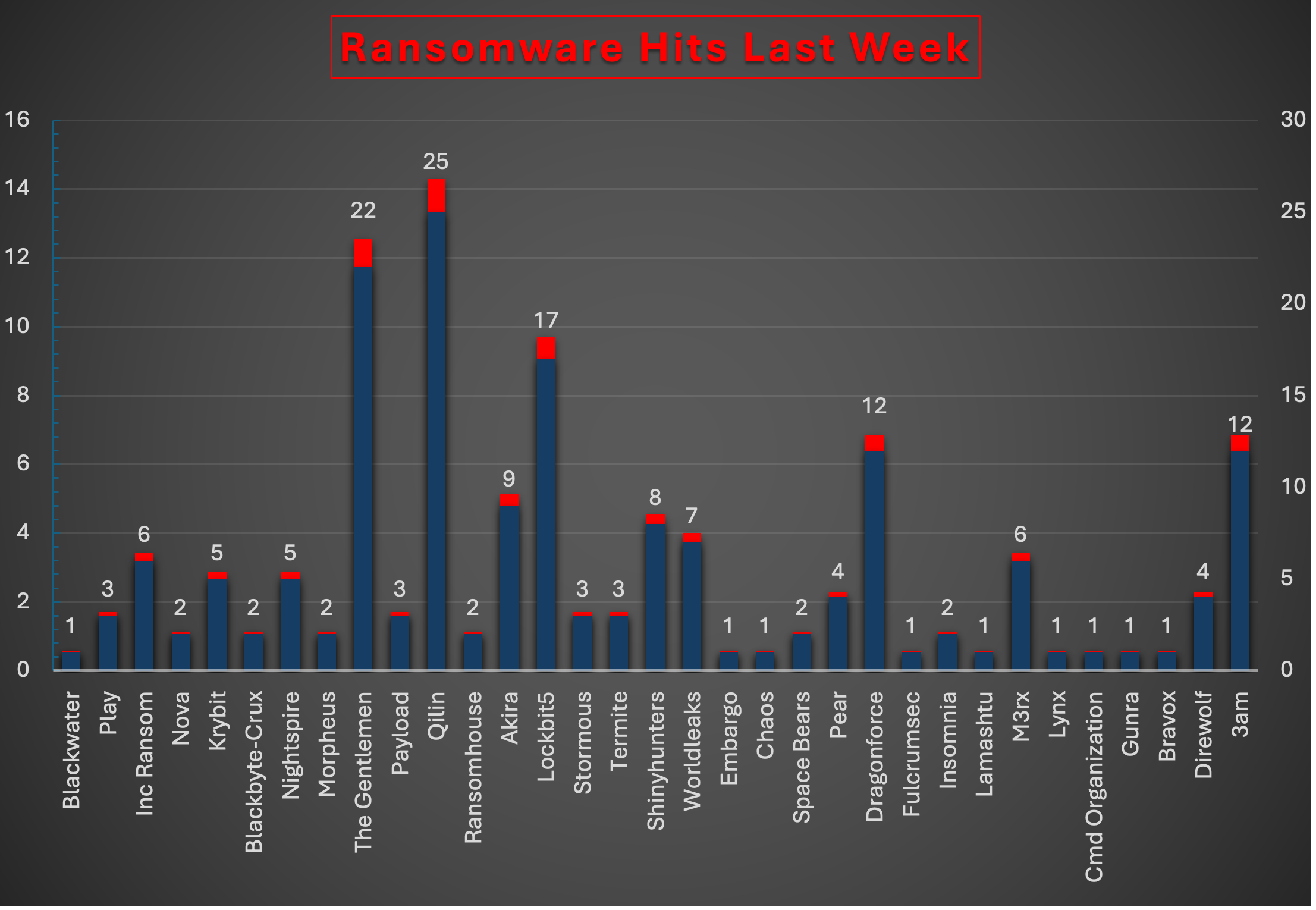
The Red Piranha Team conducts ongoing surveillance of the dark web and other channels to identify global organisations impacted by ransomware attacks. In the past week, our monitoring revealed multiple ransomware incidents across diverse threat groups, underscoring the persistent and widespread nature of these cyber risks. Presented below is a detailed breakdown of ransomware group activities during this period. Ransomware Hits Last WeekLast week’s ransomware activity was spread across multiple countries, with different ransomware groups contributing to varying levels of impact. Qilin had the highest reach, attacking 25 countries, which accounted for 14.29% of the total ransomware activity. It was followed by The Gentlemen, which impacted 22 countries, representing 12.57% of the total. Lockbit5 was also highly active, targeting 17 countries, contributing 9.71%. A second tier of activity was observed from groups such as DragonForce and 3AM, each attacking 12 countries and accounting for 6.86% of the total. Akira affected 9 countries, while ShinyHunters and WorldLeaks impacted 8 and 7 countries, respectively. Several groups showed moderate activity, including Inc Ransom and M3rx, each targeting 6 countries, while Krybit and Nightspire each attacked 5 countries. Groups such as Pear and Direwolf affected 4 countries, while Play, Payload, Stormous, and Termite each impacted 3 countries. The remaining ransomware groups had lower country-level reach, mostly affecting one or two countries each. These included Blackwater, Embargo, Chaos, Fulcrumsec, Lamashtu, Lynx, CMD Organisation, Gunra, and Bravox, each contributing 0.57% of the total activity. |
3AM Ransomware
Threat Actor Description
Origin and Identity
3AM is a Rust-based, 64-bit ransomware family that first emerged in 2023 and was first publicly documented in September 2023, when it was deployed as a fallback after an affiliate attempted to deploy LockBit and was blocked. In that original incident, the operators managed to deploy 3AM to only three machines, and it was blocked on two of the three. The name derives from both the ransom note - which opens with a reference to "3 am, the time of mysticism" - and the file extension .threeamtime applied to encrypted files, which also carry the marker string 0x666. The ransom note is dropped as RECOVER-FILES.txt. The Rust language was likely selected for encryption speed across large file sets. The strain is human-operated: operators must specify command-line parameters explicitly for each payload.
3AM is assessed to operate within the top-tier Russian-speaking ransomware ecosystem. Open-source analysis assesses it likely works under the reorganised Conti syndicate - specifically Conti's former Team 2, which became Royal and later BlackSuit. This assessment rests on a significant overlap in communication channels, backend infrastructure, and tactics, techniques, and procedures between 3AM and the Conti syndicate, including infrastructure overlaps with IcedID malware deployment and initial-access-broker activity associated with ALPHV/BlackCat. Independent analysis of the Q1 2025 social-engineering campaign reached the same conclusion - that 3AM is a rebranding of BlackSuit/Royal ransomware with ties to Conti.
The Signature Social-Engineering Campaign
3AM's most operationally significant capability is a targeted social-engineering chain documented in a first-quarter 2025 incident. The campaign combined inbox flooding with IT-department impersonation: the primary targeted employee received 24 unsolicited emails within a three-minute period, immediately followed by a voice-phishing (vishing) call that spoofed the organisation's genuine IT-department telephone number. Using the email flood as a pretext ("we are seeing a problem with your account"), the caller persuaded the user to grant remote access via Microsoft Quick Assist. The operators then delivered a QEMU virtual machine - a Windows 7 image pre-loaded with the QDoor backdoor - which ran outside the monitored operating system to evade endpoint protection.
During last-week reporting window, 3AM posted one batch of 12 victims to its leak site, all dated 12 June 2026. No victim posts were observed from 06 to 11 June 2026. The batch covered manufacturing, agriculture and food production, technology, public sector, healthcare accreditation, and professional services across nine countries.
Tactics, Techniques, and Procedures (TTPs)
Attribution Framework
|
Phase
|
Technique ID
|
Technique Name
|
Observed Behaviour
|
|
Initial Access
|
T1566
|
Phishing: Email Bombing
|
24 unsolicited emails delivered to the target within a 3-minute window via mailing-list subscription flooding, used as pretext for the follow-on vishing call.
|
|
T1598 / T1566.004
|
Spoofed-IT Vishing
|
Voice-phishing call spoofing the organisation genuine IT department phone number, persuading the user to grant remote assistance.
|
|
|
Execution
|
T1219
|
Remote Access Software: Quick Assist
|
Microsoft Quick Assist abused for hands-on-keyboard access after the user is socially engineered into granting control.
|
|
Defence Evasion
|
T1610
|
Deploy Container: QEMU Virtual Machine
|
A QEMU Windows 7 virtual machine pre-loaded with the QDoor backdoor is launched on the host to run outside the monitored OS and evade endpoint protection. Launched via Update.vbs from \ProgramData\UpdatePackage_exic\.
|
|
Command & Control
|
T1071 / T1572
|
QDoor Backdoor + Tunnelling
|
QDoor (Qt-based networking tunneler) binds to the host NIC and beacons to hardcoded C2 88.118.167[.]239:443; secondary QDoor copies (vol.exe / svchost.exe) beacon to 172.86.121[.]134.
|
|
Discovery
|
T1087 / T1482 / T1018
|
Domain & Network Discovery
|
gpresult, whoami /all, nltest /DOMAIN_TRUSTS, nltest /dclist:, quser, net group "domain Admins" /domain, net view, net share, wmic product get name,version, netstat, ipconfig /all, ping sweeps.
|
|
Privilege Escalation
|
T1136.001 / T1543
|
Account Creation + gsudo
|
New local administrator accounts created (net1 user ... /add; net1 localgroup Administrators ... /add); gsudo used for elevation; PsExec for execution.
|
|
Persistence
|
T1053.005
|
Scheduled Task (WindowsSensor15)
|
Scheduled task named WindowsSensor15 - a task name reused from a leaked Conti playbook - established for persistence.
|
|
Lateral Movement
|
T1021.001 / T1047
|
RDP + WMIC
|
RDP and WMIC remote process creation used to move to 9+ hosts. d.bat dropped to enable RDP in the registry and open the firewall. Cobalt Strike used in earlier incidents.
|
|
Defence Evasion
|
T1562.001
|
Disable MFA + EDR Killer
|
Three attempts to uninstall Duo MFA (WMIC call uninstall; scheduled task under SYSTEM; msiexec /X). EDR-killer ("EDR Sandblaster") deployed.
|
|
T1562.004
|
Modify Firewall
|
netsh advfirewall firewall set rule group="Network Discovery" new enable=Yes used to open the host firewall for discovery and movement.
|
|
|
Impact
|
T1489
|
Service Stop
|
Security and backup services stopped before encryption - including Veeam, Acronis, Ivanti, McAfee, and Symantec services.
|
|
Exfiltration
|
T1048 / T1567.002
|
Exfiltration to Cloud / FTP
|
~868 GB exfiltrated via GoodSync to Backblaze in the Q1 2025 case; historically the Wput FTP client to an attacker-controlled FTP server.
|
|
Defence Evasion
|
T1610
|
QEMU-for-Evasion (Ecosystem)
|
QEMU virtual-machine evasion is now observed across multiple actors (e.g., PayoutsKing/STAC4713; STAC3725 exploiting CitrixBleed-2 CVE-2025-5777) - shared tradecraft, not exclusive to 3AM.
|
|
Impact
|
T1486
|
Encryption Algorithm (Ecosystem)
|
No public 3AM sample analysis confirms AES/RSA specifics. BlackSuit/Royal lineage uses OpenSSL AES with intermittent/partial encryption; the 3AM -s offset parameter is consistent with this. Treat as inherited, not confirmed.
|
Command-Line Parameters
The 3AM encryptor is human-operated and accepts the following confirmed command-line parameters, which closely resemble Conti arguments:
- -k - 32 Base64-character "access key" referenced in the ransom note (the ransomware portal access key).
- -p - target path or network share to encrypt.
- -h and -m - mutually exclusive mode parameters with values "local" or "net".
- -s - offsets within files controlling encryption speed (expressed as decimal digits), consistent with intermittent/partial encryption.
Attack Lifecycle - Step-by-step
RECONNAISSANCE - Target and IT-Contact Profiling
The operator harvests employee email addresses and, critically, the organisation internal IT-department telephone number - the linchpin of the subsequent impersonation. Public-facing staff directories, breach data, and infostealer logs feed this stage.
INITIAL ACCESS (1) - Email Bombing
The target is subscribed to numerous mailing lists, flooding the inbox - 24 unsolicited emails within a three-minute window in the documented case. This serves as the pretext for the follow-on call and creates urgency and confusion.
INITIAL ACCESS (2) - Spoofed-IT Vishing
The operator calls the user via VoIP, spoofing the genuine IT-department number, and uses the email flood as the pretext ("we are seeing a problem with your account"). The matching caller ID is what makes the request credible.
INITIAL ACCESS (2) - Spoofed-IT Vishing
The operator calls the user via VoIP, spoofing the genuine IT-department number, and uses the email flood as the pretext ("we are seeing a problem with your account"). The matching caller ID is what makes the request credible.
EXECUTION - Quick Assist + QEMU VM Delivery
The caller persuades the user to grant access via Microsoft Quick Assist (Ctrl+Win+Q). The operator then delivers a payload - historically via a spoofed link redirecting to a cloud-hosted ZIP (UpdatePackage_excic.zip) extracted to \ProgramData\UpdatePackage_exic\ - and launches Update.vbs, which starts a QEMU Windows 7 virtual machine pre-loaded with the QDoor backdoor.
The QEMU launch command observed:
wexe -m 4096 -hda Update_excic.acow2 -netdev user,id=mynet0 -device e1000,netdev=mynet0 -cpu max -display none.
COMMAND & CONTROL - QDoor Backdoor
QDoor (a Qt-based networking tunneler) binds to the host network interface and beacons to its hardcoded C2 at 88.118.167[.]239:443. Secondary QDoor copies named vol.exe and svchost.exe beacon to 172.86.121[.]134. Because the backdoor runs inside the QEMU guest, host-based endpoint protection has limited visibility. The Quick Assist session is then terminated.
DISCOVERY & CREDENTIAL ACCESS - Domain Enumeration
The operator enumerates the domain using gpresult, whoami /all, nltest /DOMAIN_TRUSTS, nltest /dclist:, quser, net group "domain Admins" /domain, net view, and wmic product get name,version. A domain services account is compromised first, then a domain administrator account.
LATERAL MOVEMENT - RDP, WMIC, RMM
Using harvested credentials, the operator moves to nine or more hosts via RDP and WMIC remote process creation. A batch script (d.bat) enables RDP in the registry and opens the firewall. Commercial RMM tools (XEOXRemote, Syncro Live Agent) are installed for resilient access.
DEFENCE EVASION - MFA Uninstall + EDR Killer
The operator attempts to uninstall multi-factor authentication (Duo) three ways: WMIC ... call uninstall; a scheduled task running under SYSTEM; and msiexec /X. An EDR-killer ("EDR Sandblaster") is deployed, and security/backup services (Veeam, Acronis, Ivanti, McAfee, Symantec) are stopped.
EXFILTRATION - Cloud / FTP Staging
Approximately 868 GB of data is staged and exfiltrated via GoodSync to Backblaze cloud storage in the documented case; historically the Wput FTP client is used to push data to an attacker-controlled FTP server. A nine-day dwell preceded encryption.
IMPACT - Encryption + Extortion
Volume Shadow Copies and system-state backups are deleted.
vssadmin; wbadmin.exe delete systemstatebackup -keepVersions:0 -quiet
Encryption is launched, including remotely via
start 1l L.exe -k [key] -s 10 -m net -p \\[host IP]\c$
applying the “.threeamtime” extension and 0x666 marker. RECOVER-FILES.txt is dropped in every scanned folder.
Extortion follows via the Tor leak site, with a novel name-and-shame tactic using automated X (Twitter) bots to drive followers to the site.
Indicators Of Compromise (IOCs)
Host-Based Indicators - Files and Markers
|
Type
|
Indicator / Value
|
Description
|
|
File Extension
|
.threeamtime
|
Extension appended to all files encrypted by 3AM.
|
|
File Marker
|
0x666
|
Marker string written to encrypted files.
|
|
Ransom Note
|
RECOVER-FILES.txt
|
Ransom note dropped in every scanned folder.
|
|
Encryptor
|
L.exe / 1l
|
Remote-encryption binary invoked with -k / -s / -m / -p parameters.
|
|
Backdoor
|
QDoor (vol.exe / svchost.exe)
|
Qt-based networking tunneler; secondary copies masquerade as vol.exe / svchost.exe.
|
|
Batch Script
|
d.bat
|
Enables RDP in the registry and opens the host firewall for lateral movement.
|
|
Scheduled Task
|
WindowsSensor15
|
Persistence task; name reused from a leaked Conti playbook.
|
|
VM Image
|
Update_excic.acow2 / UpdatePackage_excic.zip
|
QEMU disk image and delivery archive extracted to \ProgramData\UpdatePackage_exic\.
|
|
EDR Killer
|
EDR Sandblaster
|
EDR-killer tool deployed to disable endpoint protection.
|
RECOVER-FILES.txt


Data Leaks

Chat server

Network Indicators
|
Type
|
Indicator / Value
|
Description
|
|
C2 IP
|
88.118.167[.]239:443
|
Primary QDoor backdoor C2 (Lithuania) - Q1 2025 incident.
|
|
C2 IP
|
172.86.121[.]134
|
Secondary QDoor C2 (vol.exe / svchost.exe beacons).
|
|
Infra IP
|
185.202.0[.]111
|
Network indicator tied to ecosystem infrastructure (original Symantec/ecosystem reporting).
|
|
Delivery
|
msquick[.]link -> 1ty[.]me -> Google Drive
|
Spoofed Quick Assist link chain redirecting to a cloud-hosted payload ZIP.
|
|
Leak Site
|
threeamkelxicjsaf2czjyz2lc4q3ngqkxhhlexyfcp2o6raw4rphyad.onion
|
3AM Tor leak site (embedded in 12 June 2026 leak-detail URLs).
|
|
Leak Site
|
threeam7fj33rv5twe5ll7gcrp3kkyyt6ez5stssixnuwh4v3csxdwqd.onion
|
Second known 3AM Tor leak-site address.
|
Confirmed Command-Line Parameters
|
Type
|
Indicator / Value
|
Description
|
|
Parameter
|
-k [32 Base64 chars]
|
Ransomware portal access key referenced in the ransom note.
|
|
Parameter
|
-p \\[host]\c$
|
Target path or network share to encrypt.
|
|
Parameter
|
-h / -m (local|net)
|
Mutually exclusive mode parameters resembling Conti arguments.
|
|
Parameter
|
-s [digits]
|
In-file offsets controlling encryption speed (intermittent encryption).
|
Confirmed Command Strings
|
Type
|
Indicator / Value
|
Description
|
|
Command
|
wbadmin.exe delete systemstatebackup -keepVersions:0 -quiet
|
System-state backup deletion prior to encryption.
|
|
Command
|
vssadmin (delete shadows)
|
Volume Shadow Copy deletion.
|
|
Command
|
netsh advfirewall firewall set rule group="Network Discovery" new enable=Yes
|
Opens firewall for discovery and lateral movement.
|
|
Command
|
net1 user ... /add; net1 localgroup Administrators ... /add
|
New local administrator account creation.
|
|
Command
|
start 1l L.exe -k [key] -s 10 -m net -p \\[IP]\c$
|
Remote-encryption execution command.
|
Mitigation - Crystal Eye 5.5 Controls
CE Email Security / Anti-phishing
Deploy CE Email Security and anti-phishing to detect email-bombing and subscription-flood patterns (high inbound volume to a single recipient in a short window). Brief staff on exactly how IT support will contact them and which remote tools are legitimately used, so spoofed-IT vishing is recognised and reported.
CEASR - Application Allowlisting
Use CEASR application allowlisting to restrict or remove Microsoft Quick Assist on endpoints that do not require it, and to block unauthorised virtualisation and RMM tooling - QEMU, XEOXRemote, Syncro Live Agent, GoodSync, and the Wput FTP client.
CE DNS Banned Domains + ForceField
Add confirmed C2 indicators (88.118.167[.]239, 172.86.121[.]134, 185.202.0[.]111) and the known 3AM leak-site onion addresses to CE DNS Banned Domains and ForceField reputation/ban lists. ForceField auto-blocks external IPs after repeated authentication failures and applies threat-context reputation blocking. Ref: ForceField; DNS Banned Domains.
CEASR + CE MDR
CEASR application, DLL, and driver allowlisting blocks EDR-killer driver loading and unauthorised MFA-agent uninstall tooling, and applies LSASS-access restriction to defeat credential dumping.
CE MDR + CESOC SIEM
Forward CE MDR endpoint telemetry to CESOC SIEM to correlate bursts of built-in discovery commands (nltest, net group, quser), creation of the WindowsSensor15 scheduled task, new local-admin account creation, and anomalous lsass.exe access.
CESOC 24x7 + Crystal AI
CESOC 24x7 monitoring correlates the cross-stage signal - email-volume spike, Quick Assist session, QEMU execution, QDoor C2, MFA-uninstall attempts, and shadow-copy deletion - into a single incident for rapid response.
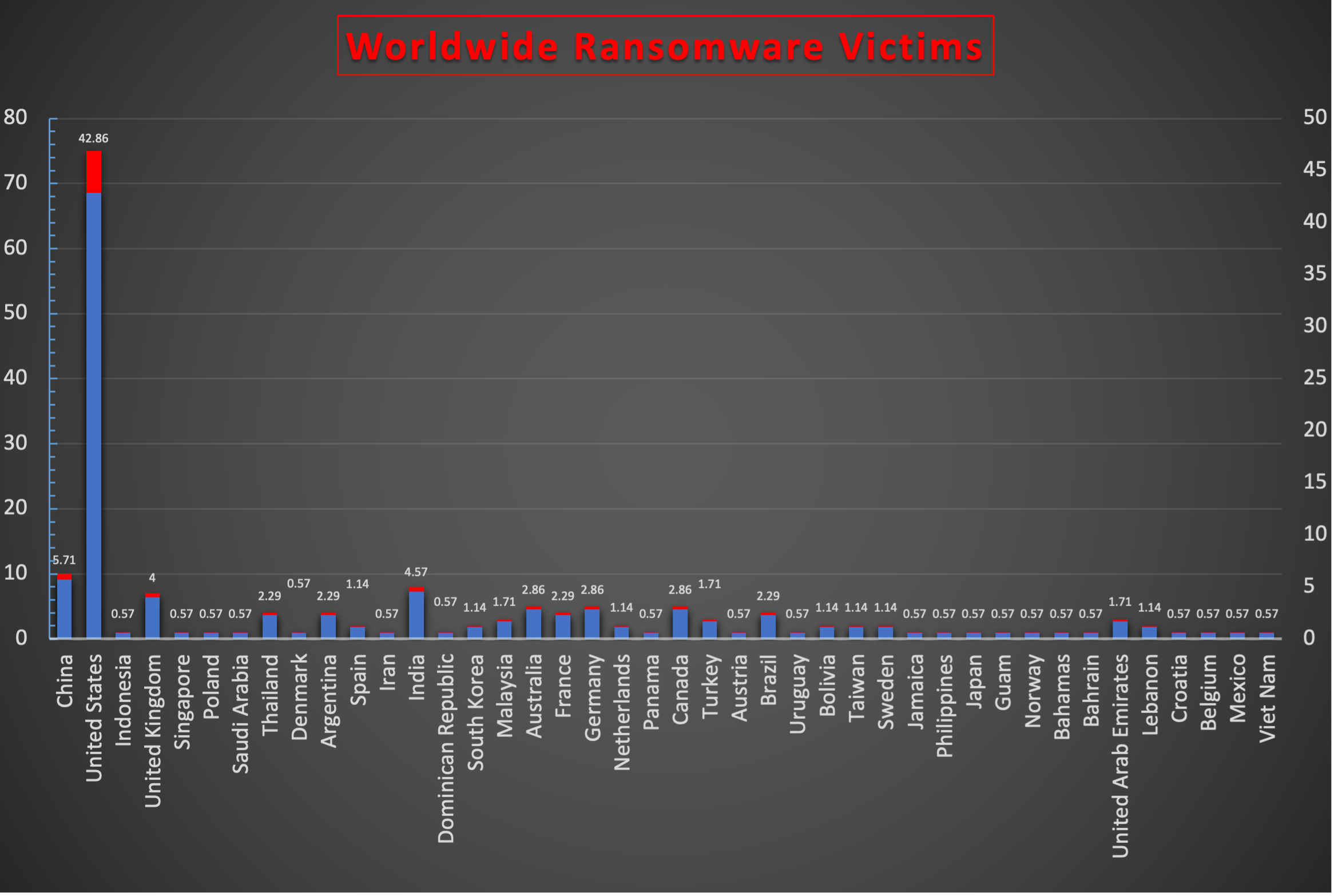
Worldwide Ransomware Victims
Worldwide ransomware victim distribution shows that the United States was the most heavily impacted country, with 75 victims, accounting for 42.86% of the total ransomware activity. This indicates that nearly half of the reported ransomware victims were based in the United States, making it the primary target region during this period.
China recorded the second-highest number of victims, with 10 cases, representing 5.71% of the total. India followed with 8 victims, contributing 4.57%, while the United Kingdom recorded 7 victims, accounting for 4.00% of global ransomware activity.
Several countries showed moderate ransomware impact, including Australia, Germany, and Canada, each with 5 victims, representing 2.86% of the total. Thailand, Argentina, France, and Brazil each recorded 4 victims, contributing 2.29% each. Countries such as Malaysia, Turkey, and the United Arab Emirates reported 3 victims each, accounting for 1.71% individually.
A number of countries experienced lower but still notable ransomware activity, including Spain, South Korea, Netherlands, Bolivia, Taiwan, Sweden, and Lebanon, each with 2 victims, representing 1.14% of the total. The remaining countries, including Indonesia, Singapore, Poland, Saudi Arabia, Denmark, Iran, Dominican Republic, Panama, Austria, Uruguay, Jamaica, Philippines, Japan, Guam, Norway, Bahamas, Bahrain, Croatia, Belgium, Mexico, and Viet Nam, each recorded 1 victim, contributing 0.57% individually.
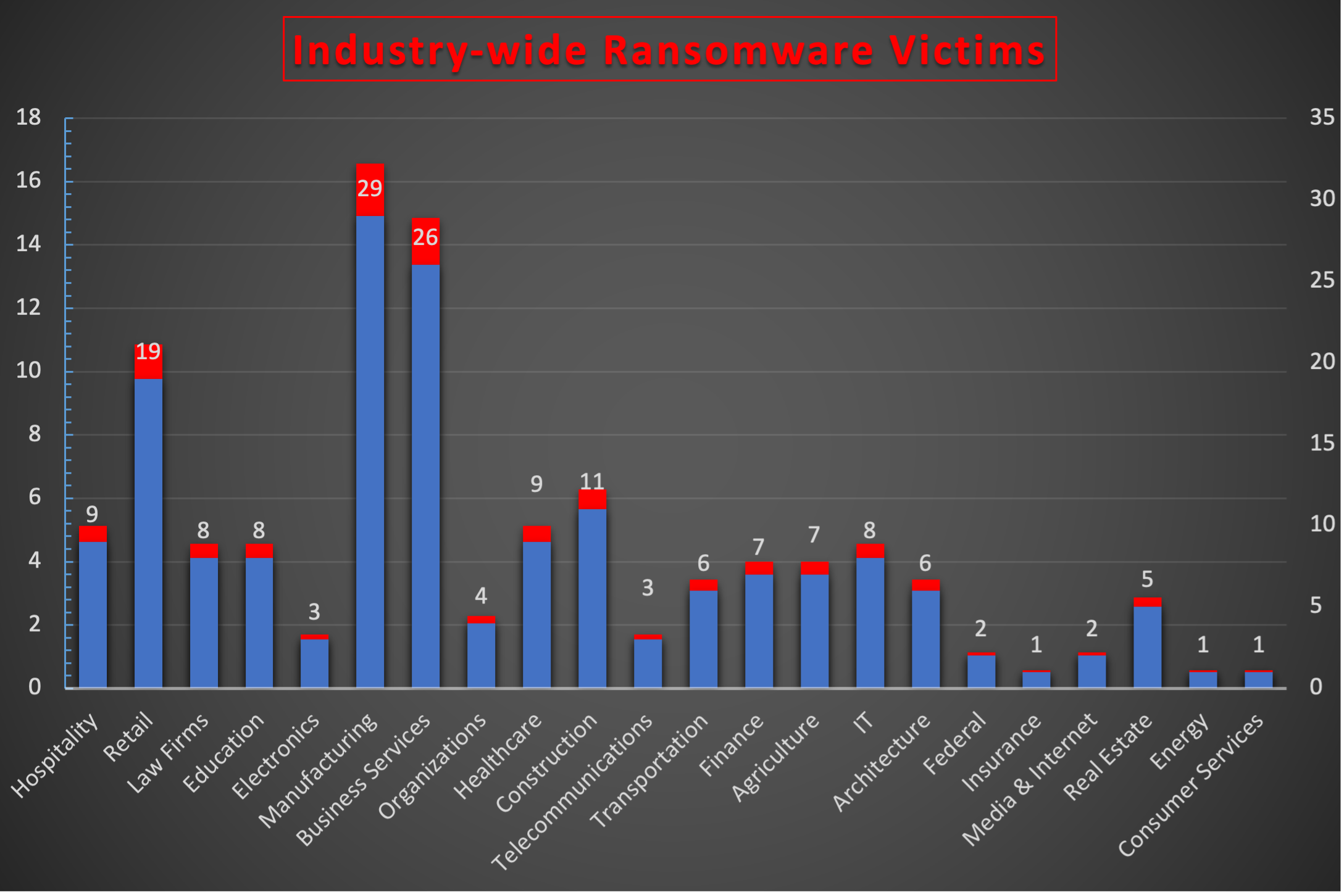
Industry-wide Ransomware Impact
Industry-wide ransomware victim data shows that Manufacturing was the most affected sector, with 29 victims, accounting for 16.57% of the total ransomware activity. This indicates that manufacturing remained the primary target industry during this period.
Business Services was the second most impacted sector, with 26 victims, representing 14.86% of the total. Retail followed with 19 victims, contributing 10.86% of overall ransomware activity.
Several industries experienced moderate levels of ransomware impact. Construction recorded 11 victims, accounting for 6.29% of the total. Hospitality and Healthcare each reported 9 victims, representing 5.14% individually. Law Firms, Education, and IT each recorded 8 victims, contributing 4.57% each.
Other affected sectors included Finance and Agriculture, each with 7 victims, accounting for 4.00% of the total. Transportation and Architecture each recorded 6 victims, representing 3.43% individually. Real Estate reported 5 victims, contributing 2.86%.
Lower levels of ransomware activity were observed in Organisations with 4 victims, Electronics and Telecommunications with 3 victims each, and Federal and Media & Internet with 2 victims each. The least affected industries were Insurance, Energy, and Consumer Services, each recording 1 victim, accounting for 0.57% of the total.